What Are the Latest Trends in LED Floor Tiles?

Time:2026-10-19 Author:Sienna
0%

If you are asking “what are the latest trends in LED floor tiles,” the answer goes beyond brighter lights. Modern systems combine interactive visuals, modular construction, and smarter control technology. Pressure-sensitive panels can react when visitors walk across them. Some floors display ripples, color trails, or synchronized patterns. Others connect with lighting consoles, mobile apps, and real-time media servers.

Energy efficiency now matters more than impressive brightness. Newer LED tiles often use improved diodes, efficient power supplies, and automatic dimming. This helps reduce heat during long exhibitions, weddings, concerts, and retail displays. Designers also prefer thinner panels with stronger surfaces. Anti-slip finishes, sealed edges, and replaceable modules can make maintenance easier. A damaged tile should not require removing the entire floor.

Practical experience still exposes weak points. Some interactive floors look spectacular but respond slowly under heavy foot traffic. Others create visible seams, glare, or uncomfortable reflections. That matters in museums, hotels, and branded events. Reliable installations require load testing, cable planning, ventilation, and professional calibration. Safety requirements also vary by location and venue type, so suppliers should provide clear technical documentation.

The market is moving toward flexible storytelling. Floors now support brand animations, game-like experiences, and immersive room designs. However, novelty alone is not enough. A successful LED floor should feel stable, readable, and comfortable beneath the visitor’s feet. The most useful trend may be balance: stronger hardware, cleaner visuals, easier repairs, and responsible energy use. Not every new feature improves the experience. Sometimes, a simpler floor performs better.
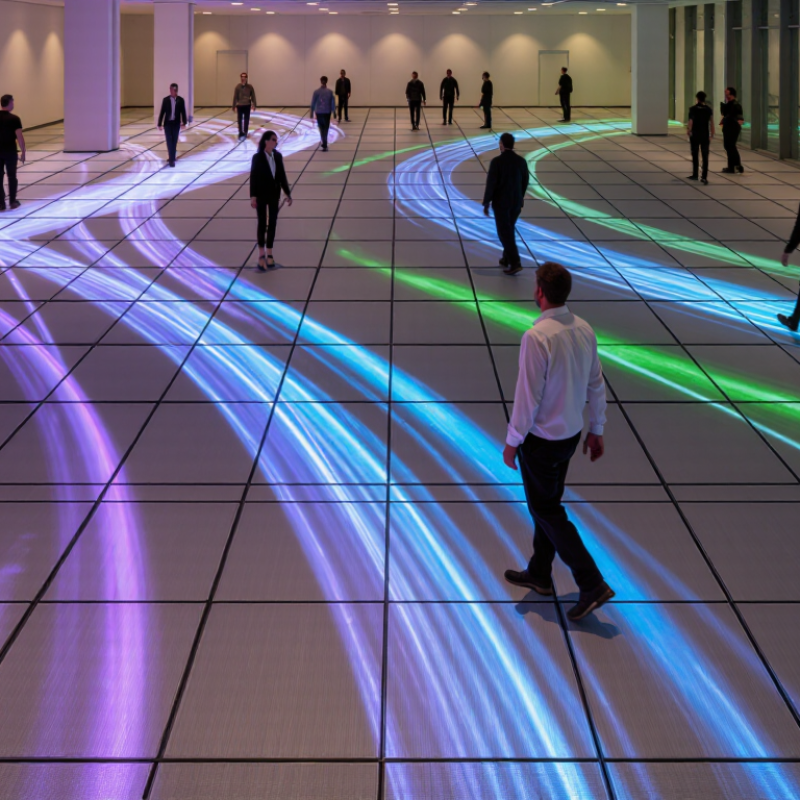
What Are the Latest Trends in LED Floor Tiles?

What Are LED Floor Tiles and How Do They Work?

LED floor tiles are modular display panels designed to be walked on. Each tile usually contains a grid of LED pixels, a control board, power supply, and protective surface. A media processor sends image data to every module. Pressure sensors can also trigger colors, animations, or sound effects when someone steps across the floor.

The surface often uses tempered glass or polycarbonate. Its load rating, slip resistance, and sealing determine whether it suits exhibitions, stages, or permanent venues.

Installation experience shows that cable routing matters as much as brightness. A beautiful floor becomes unreliable when connectors sit under walking paths.

Current designs favor interactive sensors, modular repairs, higher refresh rates, and finer pixel spacing.

A 2024 Grand View Research analysis identifies interactive LED displays as a growing application area, with the broader LED display market projected to expand through 2030.

The U.S. Department of Energy reports that LED light sources use at least 75% less energy and last up to 25 times longer than incandescent lighting, although complete floor systems consume additional power through processors and sensors. That distinction is easy to miss.

Brightness also needs restraint; excessive output can create glare, heat, and uncomfortable reflections. Manufacturers and installers should verify load tests, thermal performance, ingress protection, and maintenance access before approving a design.

Which Display and Lighting Technologies Are Advancing?

LED floor tiles are moving beyond simple color-changing panels. Display development now favors finer pixel pitches, higher refresh rates, and improved surface protection. Fine-pitch SMD and COB designs reduce visible gaps between pixels, creating smoother graphics under close viewing. MicroLED remains an emerging option, but manufacturing yield and repair costs still limit wider adoption.

Lighting technology is advancing in parallel. Tunable white LEDs can shift from cool task lighting to warmer evening tones. RGBW systems add a dedicated white channel, improving pastel colors and reducing unnecessary power use. The U.S. Department of Energy’s 2023 Solid-State Lighting R&D Opportunities report identifies approximately 230 lumens per watt as a future efficacy benchmark for general lighting.

That target matters when floor tiles operate for long events. Thermal design matters too. Aluminum frames, ventilation paths, and heat sensors help prevent brightness loss after hours of use.

Control systems are becoming more intelligent. Embedded pressure sensors, motion tracking, and ambient-light adjustment can make a floor respond to footsteps or nearby movement. The International Energy Agency reported that LEDs exceeded half of global light-source sales in 2022, showing how quickly solid-state lighting has matured. Still, brighter is not always better. Excessive brightness can flatten visual depth and create uncomfortable reflections. In practical installations, calibration often takes longer than expected. Some tiles also advertise advanced interaction but provide limited sensor accuracy. That gap deserves more honest testing.

How Are Smart Controls Transforming LED Floor Tile Systems?

Smart controls are changing LED floor tiles from static decoration into responsive architectural surfaces.

Motion sensors can detect footsteps, while pressure sensors register direction and walking speed. The floor responds.

A central controller can adjust brightness, color, and animation timing in real time. For example, tiles may glow softly under slow movement and brighten near stairs. This improves visual guidance without flooding the whole space with light.

Operators can also schedule scenes for exhibitions, retail areas, or evening events. Remote monitoring helps technicians identify inactive tiles before visitors notice them. That reduces unnecessary maintenance visits and supports more reliable operation.

Good systems use clear control logic, compatible communication protocols, and carefully tested electrical protection.

Installers should separate power planning from visual programming. Otherwise, an attractive animation may overload circuits or create uneven brightness. Energy data can reveal which scenes waste power, especially when tiles remain active in empty areas. Accessibility also needs attention. Fast flashes, harsh contrasts, or confusing patterns may disturb some users. Keep it practical.

Smart controls are not automatically intelligent. Poor sensor placement can trigger lights when curtains move or shadows pass. Calibration requires repeated testing at different heights, speeds, and ambient light levels. A manual override remains valuable during maintenance or unexpected behavior. The most dependable installations combine automation with human supervision, clear fault alerts, and documented settings. This balance may feel less futuristic, but it is easier to manage safely.

Where Are LED Floor Tiles Being Used Today?

LED floor tiles are moving beyond nightlife venues. Today, they appear in museums, retail stores, fitness studios, event halls, and interactive exhibitions. In a museum, pressure-sensitive panels can trigger river sounds as visitors cross a projected path. Retail designers use illuminated flooring to guide shoppers toward new displays. The effect is visual, but placement matters more than brightness. A crowded floor quickly loses its message.

Event planners install modular tiles beneath transparent stages, dance areas, and photo zones. These systems can react to music, footsteps, or programmed color sequences. Fitness studios use them for reaction drills, balance exercises, and group games. In hotels and restaurants, subtle light patterns can mark entrances without replacing normal safety lighting. Professional installers check load ratings, slip resistance, cable protection, and emergency access before opening. Poor ventilation or uneven subfloors can shorten service life.

Outdoor use is growing, although it is less forgiving. Covered terraces and festival walkways need weather-resistant housing, sealed connections, and careful drainage. Technicians should test glare, heat, and cleaning methods on a small section first. That step is often skipped. It should not be. Practical installations work best when technology supports walking, pausing, or exploring, instead of flashing constantly. LED floor tiles should serve the space, not consume it.

Latest Trends in LED Floor Tiles: Where Are They Used Today?

LED floor tiles are increasingly used where interactive visuals, audience engagement, and programmable lighting are important. The scores below represent relative application relevance on a 0–100 scale, not market share.

Current trends include modular installation, interactive motion effects, music synchronization, brighter full-color displays, improved load-bearing surfaces, and indoor/outdoor use with stronger protection against dust and moisture.

What Should Buyers Consider When Choosing the Latest Models?

What Are the Latest Trends in LED Floor Tiles?

The newest LED floor tiles combine interactive pixels, slimmer modules, and brighter output. Buyers should examine performance, not only visual effects. The U.S. Department of Energy reports that LED lighting can use at least 75% less energy and last up to 25 times longer than incandescent lighting. That advantage matters in venues operating displays for many hours.

Check pixel pitch, refresh rate, brightness, and viewing distance before ordering. A smaller pitch can improve close-up images, but it often increases cost and power demand. Ask for measured power consumption, not only the maximum rating. Floor systems also need strong load testing, secure connectors, and slip-resistant surfaces. Relevant IP protection should be verified under IEC 60529 conditions, especially for public areas or occasional moisture. A glossy surface may look impressive, yet fingerprints and reflections can reduce clarity. I have seen impressive demonstrations fail because maintenance access was ignored.

Tips: Request sample tiles and test them under real lighting. Confirm static load and impact results in writing. Check whether one damaged module can be replaced without removing the entire floor. Review controller compatibility, spare-part availability, warranty terms, and installation training. The U.S. Department of Energy also emphasizes thermal management because heat can reduce LED performance and service life. Buyers sometimes overlook ventilation beneath raised floors. That mistake becomes expensive. A lower-cost model may be reasonable, but only when its test data matches the intended traffic, climate, and operating schedule.

What Are the Latest Trends in LED Floor Tiles? - What Should Buyers Consider When Choosing the Latest Models?

Trend or Feature Typical Current Direction Relevant Specifications What Buyers Should Check Practical Benefit
Interactive pressure and motion response More floor systems combine LED playback with pressure, infrared, camera, or motion sensing to trigger visual effects. Sensor type, response time, detection area, maximum user load, and control protocol. Ask whether sensors are integrated or external, how they perform under heavy foot traffic, and whether effects can be programmed without proprietary software. Creates more engaging experiences for exhibitions, retail spaces, entertainment venues, and events.
Higher refresh rates for camera-friendly content Installations increasingly prioritize flicker-free performance for livestreaming, broadcast, and event photography. Refresh rates commonly specified at 1,920 Hz or higher; camera performance also depends on scan mode, shutter speed, and driving electronics. Request camera-test footage and confirm brightness consistency at different shutter speeds instead of relying only on the stated refresh rate. Reduces visible bands, flicker, and rolling-shutter artifacts in recorded content.
Fine pixel pitches and closer viewing distances Smaller pixel pitches are being used where viewers stand close to the floor or where detailed graphics are required. Common product ranges include approximately 2.5–6.25 mm pixel pitch, depending on viewing distance and application. Match pixel pitch to viewing distance, content detail, budget, power use, and replacement-part availability. Improves image detail, although a smaller pitch generally increases cost and component density.
Stronger load-bearing and impact protection Floor tiles are increasingly designed with reinforced frames, protective masks, and load-distribution structures for walking traffic. Check distributed load, point load, impact resistance, surface hardness, anti-slip rating, and structural support requirements. Verify independently tested load data and confirm whether ratings apply to the complete installed system or only the panel surface. Improves safety and service life in public areas with frequent pedestrian use.
Improved water and dust resistance Outdoor and semi-outdoor models increasingly use sealed modules, drainage planning, and protected connectors. Indoor products may have limited protection, while outdoor designs often target IP-rated protection; the exact rating must be verified for the front, rear, and connections. Confirm the tested IP rating, drainage method, connector protection, operating temperature, and installation conditions. Supports more flexible placement, but weather exposure still requires correct installation and maintenance.
Modular and tool-free maintenance Magnetic modules, front or rear service access, and replaceable power and receiving components are common priorities. Module dimensions, access direction, replacement time, spare-part compatibility, and maximum cable length. Check whether one damaged tile can be replaced without removing surrounding tiles and whether calibration data is retained after replacement. Reduces downtime and simplifies repairs in permanent and frequently transported installations.
Lower energy use and adaptive brightness Energy-conscious designs use efficient LEDs, brightness control, scheduling, and automatic adjustment for ambient light. Compare maximum and typical power consumption, brightness range, heat dissipation, standby consumption, and power-supply efficiency. Request power data for actual content rather than only maximum white-screen consumption; check ventilation and electrical capacity. Can reduce operating cost, heat output, and stress on power components.
Seamless creative layouts Installations increasingly support square, rectangular, curved, or mixed layouts instead of a single flat screen. Tile geometry, cabinet alignment, corner compatibility, pixel mapping, flatness tolerance, and allowable floor slope. Confirm that the control system supports the planned geometry and that transitions between tiles will not create visible gaps or height differences. Enables customized visual designs and more effective use of irregular spaces.
Real-time content and network control Buyers increasingly expect media-server compatibility, scheduled playback, remote monitoring, and real-time interactive control. Video input format, resolution limits, latency, synchronization, network redundancy, software compatibility, and offline playback. Test the complete signal chain and confirm who owns the content, software licenses, configuration files, and system passwords. Makes content updates easier and supports interactive or synchronized installations.
Safety, accessibility, and compliance Professional buyers place greater emphasis on anti-slip surfaces, trip prevention, electrical protection, and accessible routes. Surface friction, edge height, cable routing, grounding, residual-current protection, fire performance, and local electrical approvals. Obtain test reports for the destination market and review the installation with a qualified electrical and site-safety professional. Helps reduce operational risk and supports safer use in public environments.
Rental-ready portability Event-oriented systems favor lightweight modules, fast assembly, protective transport cases, and repeatable calibration. Tile weight, stacking method, connector durability, assembly time, case capacity, and recalibration procedure. Compare total transport weight and labor requirements, not just the weight of one tile; inspect connectors after repeated setup cycles. Improves deployment speed and reduces logistics costs for touring or temporary events.
Lifecycle value and repairability Longer service life, accessible spare parts, replaceable LEDs or modules, and documented maintenance are becoming stronger purchasing criteria. LED lifetime estimate, warranty terms, spare-part lead time, dead-pixel policy, calibration support, and expected maintenance intervals. Evaluate total cost of ownership over several years, including energy, labor, transport, replacement parts, and software support. A slightly higher purchase price may be justified when downtime and repair costs are lower.

Note: Specifications vary by product design and installation environment. Buyers should request current test reports, installation requirements, and application-specific performance data before purchase.

FAQS

Where are LED floor tiles used today?

They appear in museums, retail stores, fitness studios, event halls, hotels, and interactive exhibitions. They are not limited to nightlife. A museum path may trigger river sounds when visitors step across pressure-sensitive panels. Retail floors can guide shoppers toward a new display. Placement matters more than brightness.

How can interactive floor tiles respond?

Systems can react to footsteps, music, pressure, or programmed color sequences. A dance area might change color under each step. Fitness studios can use them for reaction drills, balance exercises, and group games. Constant flashing is usually distracting. The floor should support movement.

What should buyers check before ordering?

Check pixel pitch, refresh rate, brightness, and viewing distance. Smaller pixel pitch can sharpen close-up images. It may also raise costs and power demand. Request measured power use, not only maximum ratings. Ask for samples. Test them under the venue’s actual lighting.

Are LED floor tiles safe for public spaces?

Safety depends on load ratings, impact resistance, slip resistance, cable protection, and emergency access. Installers should inspect the subfloor and ventilation. A glossy surface may create reflections or become slippery. Normal safety lighting must remain available. Visual appeal is not enough.

Can LED floor tiles be installed outdoors?

Yes, but outdoor installations need weather-resistant housing, sealed connections, and effective drainage. Covered terraces and festival walkways are common examples. Technicians should test glare, heat, and cleaning methods on a small section. That test is often skipped. It should not be.

How do maintenance needs affect purchasing?

Confirm whether one damaged module can be replaced without removing the entire floor. Review spare-part availability, warranty terms, controller compatibility, and training. Fingerprints and dust can reduce image clarity. Leave practical access for cleaning and repairs. I have seen impressive demonstrations fail here.

How does heat affect floor tile performance?

Heat can reduce LED performance and shorten service life. Raised floors need adequate ventilation beneath the modules. Ask for thermal management details and operating limits. A cooler installation may last longer. This detail is easy to overlook.

What should buyers know about energy use?

LED lighting generally uses less energy and lasts longer than older incandescent lighting. Actual savings depend on brightness, schedule, cooling, and control settings. Ask for operating consumption under normal conditions. Maximum ratings can mislead. The lowest price is not always cheaper.

Conclusion

LED floor tiles are modular illuminated panels that combine durable walking surfaces with integrated LEDs, sensors, and control electronics. They create animated patterns, changing colors, and interactive visual effects by coordinating individual pixels or lighting zones. As display technology advances, newer models are becoming brighter, more energy efficient, thinner, and capable of producing smoother motion, sharper images, and improved color consistency. Better protective surfaces and load-bearing designs are also helping these systems perform reliably in demanding indoor and outdoor environments.

When asking what are the latest trends in LED floor tiles, smart control is a major focus. Wireless management, programmable scenes, motion detection, sound synchronization, and centralized monitoring allow users to adjust content quickly and create responsive experiences. These tiles are now used in entertainment venues, exhibitions, retail spaces, hospitality areas, event stages, fitness facilities, and public installations. Buyers should compare brightness, resolution, load capacity, slip resistance, waterproofing, maintenance access, power consumption, control compatibility, installation requirements, and long-term reliability before selecting a model.

Sienna

Sienna

Sienna is a skilled marketing professional with a deep expertise in our company’s core products and services. With a passion for innovation and detail, she plays a pivotal role in crafting insightful blog posts that not only highlight the unique features of our offerings but also provide valuable......